EASYBITS:
extractor web app

TOOLS:






Overview
Powerful AI Infra with huge
engineers dependency
The Situation
EasyBits had an AI engine that could extract structured data from complex documents, but every pipeline still depended on engineers. Customers could not configure fields, test documents, or integrate results on their own.
What I Did
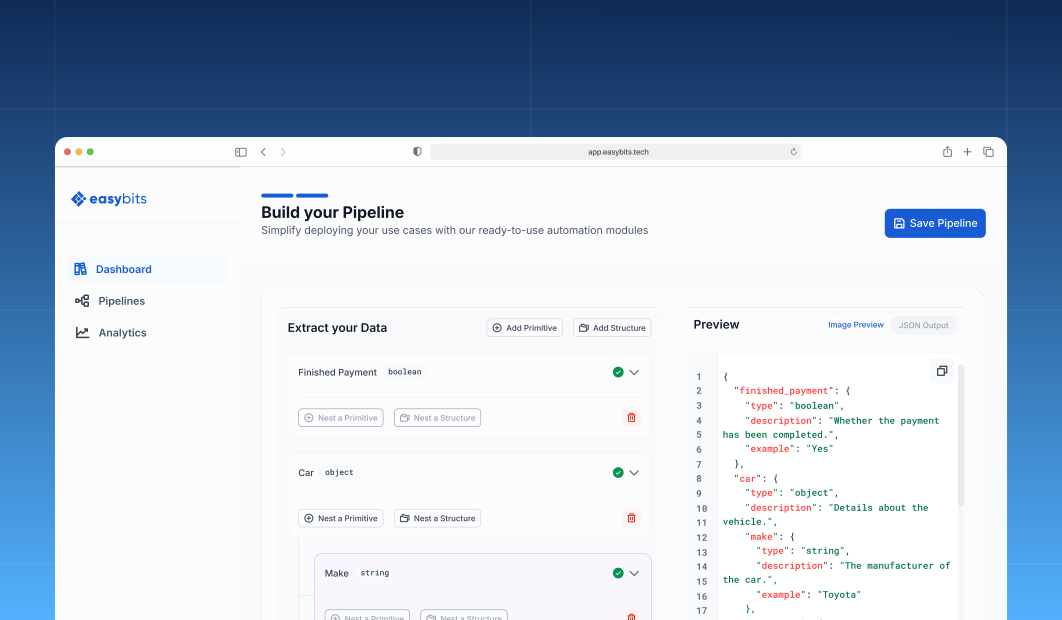
I designed the end-to-end self-service experience: pipeline setup, field mapping, document testing, result review, and API handoff. The central challenge was making nested data structures understandable without hiding the technical rules that kept outputs valid.
Team & My Role
I was the sole product designer, responsible for UX strategy, information architecture, interaction design, prototyping, and visual design. I worked closely with the CTO and engineering team through weekly reviews and continuous iteration.
Context & Origins
Bottleneck Between Great Tech
and Customer Access
Easybits was positioned as a secure, open-source AI-native data platform for regulated industries: insurance companies, consultancies, technology partners. Their core strength was building custom data extraction pipelines: feeding documents (PDFs, images, emails) into AI models and returning structured JSON outputs usable by any CRM or backend system.
The problem was access. Every new pipeline required direct engineering involvement. Sales calls were the only entry point. Onboarding was slow and manual. Potential customers who wanted to test the technology had no way to do it independently.
Two pressures converged to make this the right moment to build a self-service tool:
Sales Bottleneck
The team was generating around 5 demo calls per week but converting them required significant hands-on time from dev team. A self-service tool would let prospects validate the product themselves.
Investor pressure
Investors wanted to see product adoption metrics and independent usage — not just custom contracts. A self-service platform would generate exactly that.
effectiveness
45,000+ docs
processed by the extraction engine in production without reported errors
scope
0→1 product
from engineering-led demos to customer self-service
early adoption
3 users
onboarded within days of launch